What Is Financial Outsourcing? An Overview for UK Businesses
Financial outsourcing for UK businesses. Covers FCA SYSC 8, Consumer Duty, UK GDPR, GBP cost comparisons and outsourcing models.

Financial outsourcing means engaging an external provider to handle financial functions that would otherwise be performed by in-house staff. This typically falls under the umbrella term of business process outsourcing (BPO), a commercial outsourcing model.
In the United Kingdom, this covers everything from bookkeeping and VAT returns through to suitability report preparation, pension administration and full back-office operations for IFA networks, wealth managers and insurance brokers.
The term covers a very broad spectrum as financial services is naturally a broad subset of specialist areas.
At one end, a sole practitioner IFA sends overflow suitability reports to an external team on a per-job basis. At the other end, a national advisory firm operates a 30-person dedicated offshore team that handles paraplanning, practice administration and client service duties under a formal governance framework.
What Finance Functions Can Be Outsourced?
Most financial services firms outsource operational and administrative functions that are process-driven, repeatable and do not require the practitioner to be physically present.
The most commonly outsourced finance functions in the UK fall into three categories.
Financial Planning and Advice Support
- Suitability report preparation and review
- Cash flow modelling and retirement projections
- Client file notes, research and provider comparisons
- Pension transfer analysis (CETV analysis)
- New business processing and platform submissions
- Ongoing client administration and annual review preparation
For a detailed scope of what can be outsourced in financial planning, see Paraplanning Outsourcing Scope.
Accounting and Tax
- Bookkeeping and bank reconciliations
- VAT return preparation and submission
- Self Assessment tax returns (SA100, SA800)
- Corporation Tax returns (CT600) and Companies House filings
- Payroll processing, PAYE and Real Time Information (RTI) submissions
- Year-end accounts preparation and management reporting
For a detailed scope, see On Demand Accounting Duties.
Insurance
- New business processing and application submission
- Mid-term adjustments and policy amendments
- Renewal preparation and review
- Claims notification and tracking
- Commission reconciliation
- Client correspondence and inbox management
For a detailed scope, see Insurance Outsourcing Scope.
How Financial Outsourcing Works in Practice
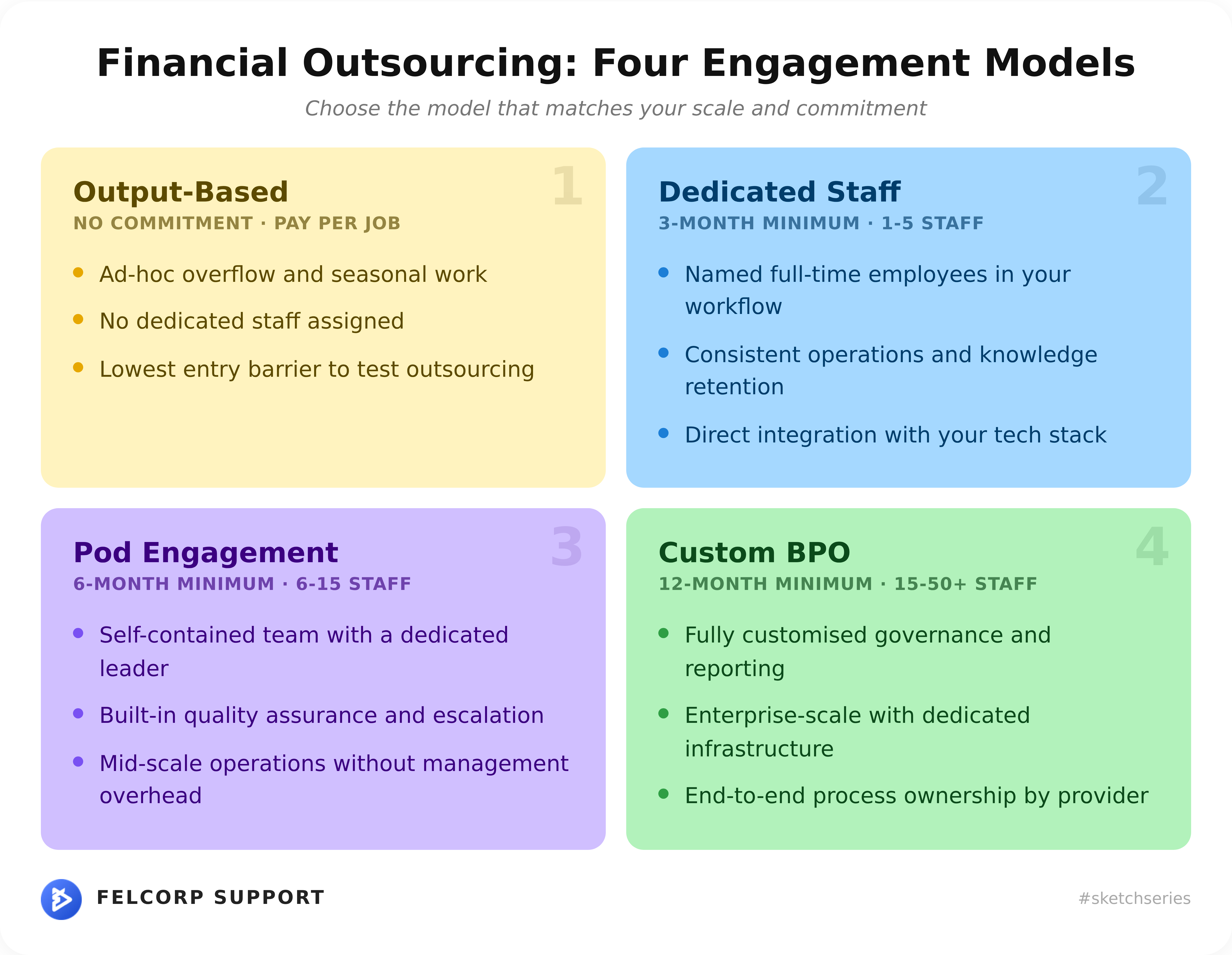
There are four distinct models for outsourcing financial functions. Each operates differently in terms of cost structure, staff allocation and commitment.
| Model | How It Works | Best For | Commitment |
|---|---|---|---|
| Output-Based (On Demand) | Submit individual jobs, pay per deliverable. No dedicated staff. | Ad-hoc, overflow, seasonal work | None. Prepaid credits only. |
| Dedicated Staff | Engage named, full-time staff who work exclusively for your business. | Consistent, ongoing operations (1 to 5 staff) | 3 months, then month-to-month |
| Pod Engagement | Self-contained team with dedicated team leader, structured workflows and built-in QA. | Mid-scale operations (6 to 15 staff) | 6 months minimum |
| Custom BPO | Fully customised operation with dedicated management, governance framework and reporting. | Enterprise-scale operations (15 to 50+ staff) | 12 months minimum |
As an example, Felcorp has service offerings across all 4 models:
5 Benefits of Financial Outsourcing
1. Cost Reduction
Outsourcing reduces the fully loaded cost of employment. This is primarily due to wage arbitrage, where offshore operations are based in countries with wages 50-70% lower than equivalent UK compensation levels.
A mid-level paraplanner or financial planning administrator hired locally in the UK typically costs £40,000 to £55,000 per year when salary, employer National Insurance contributions (13.8%), workplace pension contributions (minimum 3%), holiday pay, recruitment fees and office overhead are included.
An equivalent offshore staff member through a managed BPO provider costs significantly less while operating under structured supervision and quality assurance.
As a quick real life comparison example, the table below represents Felcorp's service fees for Full Time Staff Engagement against onshore equivalent full time salaries in the UK market.
| Level | Experience | Felcorp Monthly | UK Equivalent | Monthly Savings |
|---|---|---|---|---|
| Junior | 0 to 2 years | ~£1,750 GBP | £2,500 to £3,200 | £750 to £1,450 |
| Intermediate | 2 to 4 years | ~£1,950 GBP | £3,300 to £4,600 | £1,350 to £2,650 |
| Senior | 4+ years | ~£2,200 GBP | £4,600 to £6,700 | £2,400 to £4,500 |
| Felcorp rates are billed in AUD and shown here as approximate GBP equivalents. GBP figures will vary with the AUD/GBP exchange rate. UK cost estimates include base salary plus employer National Insurance (13.8%), workplace pension contributions (minimum 3%), statutory leave entitlements and recruitment costs, calculated as monthly equivalents. UK estimates exclude office overhead, equipment and professional development which typically add a further 10% to 20%. See BPO Pricing for current Felcorp rates. | ||||
The cost comparison is not just salary. It includes the infrastructure, office space, equipment, training, supervision and HR overhead that a managed provider absorbs into their fee.
As the table above illustrates, savings on a single role can range from £750 to £4,500 per month depending on seniority. Those savings compound quickly with team size.
An engagement of 2 to 5 staff members can deliver £3,000 to £18,000 or more in monthly savings compared to hiring locally, before factoring in additional overhead costs like office space, equipment and recruitment fees.
For a full cost comparison across engagement types, see How Much Does a BPO Cost?
2. Access to Specialist Skills
Financial outsourcing providers that specialise in UK financial services maintain staff trained in local regulatory frameworks, software platforms and compliance requirements. This is different from general outsourcing where staff may have no familiarity with FCA conduct rules, HMRC filing requirements or UK advice document standards.
Felcorp staff work with UK financial planning platforms (Intelliflo, True Potential, Xplan), cash flow modelling tools (Voyant, CashCalc), accounting software (Xero, Sage, FreeAgent, QuickBooks) and insurance systems specific to the UK market.
3. Scalability Without Recruitment Risk
Outsourcing allows you to scale capacity up or down without the recruitment lead time, redundancy risk and fixed overhead of local hiring. If your workflow grows, you add staff. If it contracts, you reduce. Most outsourcing models offer flexible terms that local employment cannot match.
4. Business Continuity and Reduced Key Person Risk
Relying on a single in-house bookkeeper, paraplanner or administrator creates a single point of failure. If that person is ill, on leave or resigns, your operations stall. An outsourcing provider maintains bench capacity and can replace staff without disrupting your workflow.
Brain drain is a real problem in small business. When key persons leave, that institutional and contextual practice knowledge is gone for good. Given that in general, two good offshore staff equal the price of one onshore local staff member, we always recommend firms take 2 offshore staff because we can better ensure business continuity and reduce the risk of brain drain by 50% - Tobias Fellas, CEO of Felcorp Support
5. Focus on Client-Facing Work
The most valuable work a financial adviser, accountant or insurance broker does is client-facing. Every hour spent on back-office processing, data entry or document preparation is an hour not spent on revenue-generating activity. Outsourcing shifts operational work to a dedicated team so practitioners can focus on advice, client relationships and business development.
Regulatory Considerations in the United Kingdom
Outsourcing financial functions in the United Kingdom operates under a clear regulatory principle: you remain responsible for all functions performed under your authorisation, regardless of who performs them.
For financial advisers and wealth managers, the FCA's outsourcing rules under SYSC 8 establish that regulated firms retain full responsibility for outsourced functions. SYSC 8.1.1R requires firms to take reasonable care to avoid undue operational risk when outsourcing critical or important functions, and firms must maintain the same level of oversight as if the function were performed internally.
The FCA Consumer Duty (in force since July 2023) adds a further layer. Firms must ensure that outsourced activities deliver good outcomes for retail customers, and the Duty applies to all parts of the distribution chain including outsourced service providers.
For accountants in practice, ICAEW and ACCA professional standards require that all work performed under a member's name meets the same professional and ethical standards regardless of where or by whom it is performed. Anti-money laundering obligations under the Money Laundering Regulations 2017 also require firms to assess and manage the risks associated with outsourced customer due diligence.
For tax agents, HMRC's agent standards require that all work submitted under a registered agent's credentials meets the same professional standards regardless of who performs the underlying preparation.
The practical implication is that your outsourcing provider must operate with documented procedures, formal supervision, quality assurance processes and data security controls that you can audit and evidence. The regulatory burden does not transfer when you outsource. The operational burden does.
Data protection adds a specific dimension for UK firms. The UK GDPR and Data Protection Act 2018 require that any transfer of personal data to a third-party processor (including offshore providers) is covered by appropriate safeguards. This typically means standard contractual clauses or binding corporate rules for transfers outside the UK's adequacy framework.
Felcorp has built UK financial services regulation directly into the structure of its contracts and operations. The United Kingdom Jurisdictional Addendum (Schedule 10C) forms part of every UK engagement and addresses FCA outsourcing requirements under SYSC 8, Consumer Duty obligations across the distribution chain, data protection compliance under UK GDPR including international transfer safeguards, ICAEW and ACCA professional standards for accounting engagements, anti-money laundering obligations under the Money Laundering Regulations 2017 and consumer protection requirements under UK law. Every clause in Schedule 10C exists because a specific regulatory obligation in UK financial services demanded it. That level of specificity separates a purpose-built framework from the generic outsourcing agreements that dominate the market.
For a deeper analysis of how compliance expectations are evolving around offshore outsourcing, see What to Expect from Offshore Paraplanning Providers in 2026.
Onshore vs Offshore: What UK Businesses Should Know
Most businesses frame the outsourcing decision around geography. Onshore feels safer. Offshore feels cheaper. But geography alone does not determine quality, security or compliance outcomes. What determines those outcomes is how the operation is managed. A managed offshore provider with on-site offices, formal supervision, embedded QA and documented security controls presents lower operational risk than an unmanaged local contractor with no oversight framework.
| Factor | Onshore (UK Provider) | Managed Offshore (e.g. Felcorp) | Unmanaged Offshore / Freelance |
|---|---|---|---|
| Cost | Highest | Mid-range, all-inclusive | Lowest upfront, hidden costs |
| Supervision | Your responsibility | Provider-managed, on-site | Your responsibility, remote |
| Quality Assurance | Varies by provider | Embedded in every deliverable | None unless you build it |
| Data Security | Subject to UK GDPR | Managed office, device control, NDAs, SCCs | High risk, WFH, uncontrolled devices |
| Regulatory Risk | Lower, but still your responsibility | Lower, with documented governance | Highest, minimal documentation |
| Staff Replacement | You recruit | Provider replaces at no cost | You recruit |
For more on this distinction, see Dedicated Teams vs Shared Services and Common Security Risks in BPO.
Is Financial Outsourcing Right for Your Business?
Financial outsourcing is not universally appropriate. It works best in specific circumstances.
Outsourcing is a strong fit if:
- You have repeatable, process-driven work consuming practitioner time
- Your workflow is growing faster than you can recruit locally
- You want to reduce key person risk in your operations
- You need to scale capacity without proportional fixed cost increases
- You are comfortable with documented oversight rather than physical proximity
Outsourcing may not be the right fit if:
- Your work requires constant, real-time client interaction that cannot be structured into tasks
- You have fewer than 10 hours per week of outsourcing work (the economics rarely justify the setup)
- You are unable or unwilling to invest time in initial onboarding and process documentation
For a broader perspective, see When Is the Right Time to Consider BPO? and When BPO Is Not the Right Solution.
Getting Started
If you are evaluating financial outsourcing for the first time, the lowest-risk entry point is a structured trial. Felcorp's BPO Services Trial validates service quality against your real workflow with a 100% money-back guarantee.
The trial produces documented SOPs and deliverables that carry directly into an ongoing engagement if you proceed. See the trial page for current pricing and inclusions.
For practices ready to engage dedicated staff, see BPO Pricing for current rates. For enterprise-scale requirements, see Pod Engagements and Custom BPO Solutions.
Written by Tobias Fellas, Founder & CEO at Felcorp Support.